
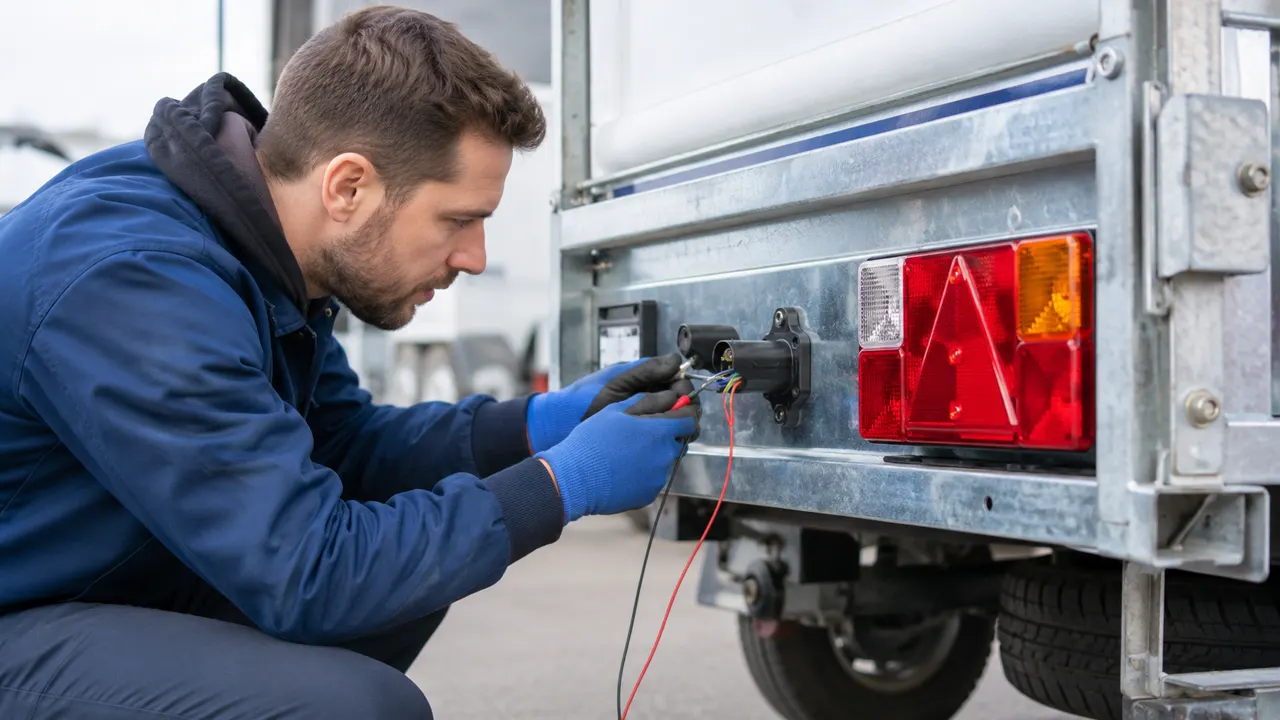
Trailer lights are essential for road safety. If brake lights, turn signals, tail lights, or running lights stop working, the problem may come from the towing vehicle, trailer connector, ground wire, fuse, bulb, or damaged wiring.
Common Causes of Trailer Light Failure
Trailer lights may fail because of:
- Bad ground connection
- Blown fuse
- Corroded trailer plug
- Broken wire
- Loose connector
- Burned bulb
- Damaged light housing
- Incorrect wiring
Step 1: Check the Tow Vehicle
Before inspecting the trailer, confirm that the tow vehicle lighting system is working. Test the brake lights, turn signals, hazard lights, and running lights.
Step 2: Test the Trailer Connector
Use a circuit tester to check the output at the vehicle trailer socket. Activate each signal and test the corresponding terminal.
If the vehicle socket has no power, check the vehicle fuse, relay, or wiring.
Step 3: Inspect the Trailer Plug
Look for corrosion, dirt, bent pins, or loose terminals. Clean the plug if necessary.
Step 4: Check the Ground Connection
A poor ground is one of the most common trailer lighting problems. Make sure the ground wire is securely attached to clean metal on the trailer frame.
Rust, paint, or loose screws can create ground failure.
Step 5: Inspect the Wiring
Follow the trailer wiring harness from the plug to each light. Look for cuts, crushed wires, exposed copper, loose connectors, or damaged insulation.
Step 6: Test Each Light
Check each bulb or LED light assembly. Replace damaged bulbs or faulty light units.
Conclusion
Trailer light problems can usually be diagnosed with a circuit tester, wiring connectors, fuse kit, and basic repair tools. A systematic troubleshooting process helps avoid unnecessary part replacement.
AutoVoltCore supplies trailer wiring repair kits, circuit testers, heat shrink connectors, and automotive electrical accessories for repair shops, trailer service businesses, and distributors.